
Why public defense advocacy is a high priority for me

Updated: Apr 13
The greatest crime of all in a civilized society is an unjust conviction. It is truly a scandal that reflects unfavorably on all participants in the criminal justice system.
— The New York Appellate Division, First Department,
People v. Ramos, 1994.
I have been asked from time to time why I am so passionate about the issue of public defense, and why it is the focus of so much of our work at Society Impact. For me, it’s very personal.
When I practiced law, I devoted a substantial amount of my time to pro-bono work at Westchester Legal Services on evictions and foreclosures. But I had no idea of the magnitude of the challenges in public criminal defense.
When I first came home after being prosecuted and tried in a case in which I was denied effective, conflict-free counsel—an experience that resulted in my imprisonment—I made a deliberate choice that my time and resources were best spent working to change the criminal legal system rather than dwelling on my own personal encounters with it. My sentence has terminated and the conviction has been sealed. I wanted to help other system participants, not talk about myself. And in the past thirteen years, I believe I’ve made much progress toward that goal.
But there comes a point when silence stops serving a purpose. This is the first time I’ve included my own case in my writing since I began my post-conviction work. Given the multiple crises facing our criminal legal system today, and the growing recognition that a strong, well-resourced public defense bar is essential to preserving liberty and the rule of law, I’ve come to believe that it’s an appropriate time to share my story as an illustration.
What follows is not just a personal account, but an example of a broader problem. We can all learn from this ordeal and do better.
Before I begin, let me be clear: while I recount in this story the ways in which my court-appointed counsel failed me, this is not a reflection on the entire public defense profession. I know many public defenders who are outstanding lawyers who provide invaluable services for low-income defendants, and they have my utmost respect. But the failures I experienced are part of a pattern that occurs often enough in our criminal legal system that it cannot be ignored.
My Trial
Twenty-two years ago today, I was forced to face a criminal trial without effective assistance of conflict-free counsel—a fifteen-week trial that would change the course of my life forever and result in a sentence of 7–21 years in New York State maximum and medium security prisons, beginning at Clinton Correctional Facility in Dannemora, New York.
On the opening day of a bench trial at the Dutchess County Courthouse in Poughkeepsie, New York, my court-appointed counsel testified against me on the record immediately before opening statements. This happened in connection with his voluntary and unilateral motion to be relieved as my counsel in a white-collar indictment brought by then-Attorney General Eliot Spitzer, who was deeply compromised at the time.
The case involved business transactions with individuals connected to a former New York State governor as well as others, a high-level misuse of the criminal legal system. It was widely publicized through statements and media outreach orchestrated by the Attorney General’s office, which shaped a public narrative that included falsehoods that persist to this day. The prosecution was pursued on questionable jurisdictional grounds, as later confirmed by official New York State records and documents obtained from the New York State Archives and other state agencies during an investigation conducted by my attorneys in New York City in 2016. The results of that investigation are available here.
I won’t pretend that I didn’t make some naive decisions or have misplaced trust in certain parties I chose to do business with, but I never made any choices in bad faith or outside the bounds of the law, and I worked diligently to achieve favorable outcomes in the contractual matters which Mr. Spitzer ultimately transformed into a criminal indictment. In any case, no mistake strips a person of their constitutional right to fair and effective representation in court. There is no justification for the way in which my trial was conducted.
Before I go further, I should clarify some necessary background.
The foundation of Mr. Spitzer’s indictment in this case was the prosecution’s theory of larceny by false promise. This theory asserts that, at the time I made a contractual promise, I allegedly had no intention of performing it. Because the underlying conduct in such cases is civil in nature, and because the proof is entirely circumstantial, the level of proof required to establish criminal intent at trial is especially high. It exceeds the already rigorous “beyond a reasonable doubt” standard and rises to proof “beyond a reasonable doubt to a moral certainty,” excluding any non-criminal explanation of the conduct in question.
Although this heightened standard applied to every count, the court returned inconsistent verdicts under the same prosecutorial theory. These inconsistencies underscore the impact that a thorough and effective defense could have had. Had my attorney reviewed and utilized the thousands of pages of transactional documents and called witnesses to testify regarding the nature of the transactions, it is clear that none of the convictions could have been sustained.
As mentioned, the entire indictment in my case was based on this same theory—larceny by false promise. Accordingly, this heightened standard applied uniformly to every count. Yet, in this non-jury bench trial, the court acquitted me on 25 of 38 counts and convicted me on 13, all under the same prosecutorial theory. These inconsistent verdicts further demonstrate that, had a defense been properly presented—had my attorney reviewed and utilized the thousands of pages of transactional documents and called witnesses to testify regarding the nature of the transactions—there is no possible way any of those 13 counts could have resulted in conviction.
Now consider just one of the many glaring examples. Within a month of my conviction, two prosecution witnesses from one of the counts brought a civil action against me in federal district court, using the criminal conviction as a predicate for proof. I defended the case pro se from prison. The United States District Court dismissed the action by summary judgment, sua sponte—on its own initiative—because the allegations of fraud did not even meet the minimal standard required in a civil case. They did not rise to the level of a triable issue of fact. Consider the contrast: the state trial court found me guilty beyond a reasonable doubt, to a moral certainty, excluding any civil explanation. Yet a federal judge, reviewing the same underlying facts in a civil context, dismissed the case outright because it did not even present a legally sufficient claim.
As the saying goes, you can’t make this up. This is all a matter of public record. For any defendant to attempt to navigate circumstances like these without effective legal representation is impossible. It is like playing a game of Scrabble while your opponent has hidden ten of the tiles in their pocket. And that is why the paragraphs that follow are so important to share.
On February 4, 2004, the trial judge—specially assigned from outside the county—appointed my court-appointed counsel, colleagues of approximately twenty years, to represent me. This appointment was made over my objections, despite counsel’s on-the-record disclosure in his initial appearance in the case of conflicts of interest directly affecting my defense, and despite my insistence on being represented by retained counsel of my own choosing.
In other words, before the trial even began, the foundation of my defense had already been compromised.
These problems began much earlier. Eliot Spitzer disqualified my initial attorney by arresting him alongside me in September 2002, only to dismiss the charges against him shortly afterward. He then orchestrated the restraining of my assets and accounts preventing me from continuing to pay my second retained attorney. Although that attorney was current on payment at the time, he initially moved to be relieved after an Assistant Attorney General advised him that I would be unable to sustain his billing over the lengthy trial they intended to pursue.
I suspect Mr. Spitzer’s office never believed I would take the case to trial and assumed I would accept a plea. At a July 2003 pre-trial conference, following an Assistant Attorney General’s unsuccessful attempt to revoke my bail, a senior member of the Attorney General’s office approached me and my counsel with a plea offer that would have resulted in a conviction on a lesser count and little-to-no prison time. I rejected it. From that point forward, it was clear they were determined to force a plea and obtain a conviction by any means, fair or foul.
It became evident at trial that they were unprepared to secure a fair and lawful conviction. The proceedings felt somewhere between a chapter of Kafka’s The Trial and the final episode of Seinfeld. The pressure intensified, and the core issue remained: I did not have a lawyer who could effectively represent me.
A third private attorney agreed to represent me but required a brief adjournment to prepare and attend to existing obligations. The Court denied that request. Unbeknownst to me, and over my objection, the judge had already appointed me an attorney. That is how he came to represent me. I was denied my right to conflict-free retained counsel of my choice.
My court-appointed counsel moved in open court to be relieved from representation, citing a confidential letter I had written to him the previous day. In that letter, I respectfully requested that he seek a short adjournment so he could review the sixty or so cartons of case files I had provided him the month before—files that he admitted on the record he had barely examined. This review was essential for him to properly defend me in a complex, multi-count criminal indictment based on civil contract transactions that revolved entirely around questions of my honesty.
In his testimony, my court-appointed counsel informed the trier of fact, in this non-jury bench trial, that I was dishonest; that he could not believe a word I said; that he would have to argue against matters I raised in my defense; and that he could not zealously or effectively represent me. He literally allocuted to—and cited—black-letter New York Court of Appeals case law, People v. Sides (1990), defining a per se conflict of interest requiring the mandatory granting of his motion to be relieved.
If that were not enough, an Assistant Attorney General opposed his motion to withdraw and also testified against me, claiming that I had caused his motion by writing a “bogus” letter and that my entire defense would be “bogus and phony.” Another member of the prosecution team, whom my counsel identified on the record as a longtime personal
friend, then moved to revoke my bail and remand me based on my “state of mind” in writing the letter requesting a short adjournment to allow my lawyer to prepare.
At that moment, any meaningful semblance of a fair trial had already collapsed.
The Court denied court appointed counsel’s motion, refused to grant my new retained lawyer a brief adjournment to take the case, forced my counsel’s self-admitted, conflicted, ineffective representation upon me, and began the trial that very day—March 30, 2004. For fifteen weeks, I was effectively unrepresented as the state proceeded through a trial whose fundamental unfairness was apparent, resulting in a conviction that was then—and remains—unworthy of confidence.
During the lunch break that day, I followed my counsel to the luncheonette across the street from the courthouse and asked him why he did what he did. I asked him, “Didn’t what you said prejudice the judge against me?”
“Probably,” he answered. He was eating a tuna sandwich. I have not been able to bear the sight or smell of tuna fish since.
In the weeks leading up to trial, from his first appearance in January through his appointment, my counsel met with me only once, and only briefly.
On March 28, 2004, I wrote the letter at issue after waiting more than six hours outside his office in Fishkill, New York, hoping to meet with him to discuss the case. He refused to see me. I had gone there because my calls and emails in the preceding week had gone unanswered, and I needed to know whether he had secured the adjournment of the trial scheduled to begin the next day, something he had promised as a condition of my agreeing to waive a jury and proceed with a bench trial.
He had pressured me into that decision, telling me it was the only way to convince the Court to move the trial date and give him time to review the materials I had provided and investigate the case. He said the time saved on jury selection would make that possible. I had no experience in these matters, and I was terrified. I agreed.
I had driven there from my home in Vermont. On the three-hour drive back—a trip I would make repeatedly over the next fifteen weeks—he finally called me on my cell phone to say that the trial would proceed as scheduled the next day, and that if I didn’t like it, I could try the case myself.
The following morning, I hand-delivered the letter to him in the courtroom. In it, I reminded him that my waiver of a jury trial was expressly conditioned on his obtaining an adjournment to prepare, and that if no adjournment would be granted, I wished to withdraw that waiver.
Both my appointed counsel and the Court ignored the request. Instead, during the March 30 colloquy, the prosecutors characterized the letter as a fabricated delay tactic, claiming it was a scheme I had contrived to postpone the trial. It was not. It was a desperate attempt to ensure that my lawyer had time to prepare a defense.
My appointed counsel never called or interviewed any witnesses, never read the files, never utilized his allocation to hire an investigator, and refused to present a defense. I was effectively muzzled during the trial. When I tried to pass him notes correcting misstatements by the prosecutor or prosecution witnesses, he would sometimes roll up the paper and throw it back at me in full view of the Court.
During one such incident, involving a prosecution witness, I said, “But he is lying.” His response: “Well, you will have a long time to think about it, won’t you?”
On the final day of trial, I followed him to the parking lot to plead with him to present a defense. Again, he did not meet with me once during the entire trial, so this is how I had to communicate with him. The sixty boxes of files I had given him that February—which he had placed in his vehicle—remained intact, unmoved, and unopened in the bed of his pickup truck. My appointed counsel again refused, this time telling me he was not going to spend the rest of the summer on my case. All I could remember was March 30th. I had been muzzled from that day on. The trial judge did not want to hear from me. When I tried, he said, “Mr. Zarro, this court does not do dual representation. Speak through your lawyer.” I was scared and resigned to the inevitable outcome. All I could do was what I had been doing: show up on the next court date.
He rested the case, and closing arguments were conducted at 10:00 a.m. on July 8, 2004, fifteen weeks after the commencement of trial. At 4:00 p.m. that same afternoon, the trial judge acquitted me on 25 of the 38 counts in the indictment and convicted me on 13. I was immediately remanded to the county jail, cuffed, shackled, and taken away.
My appointed counsel never visited me there and refused to discuss the case with my family. When my sister called him, he warned that if she contacted him again, he would inform the Court and move to be relieved—this time before sentencing—and that it would not go well for me.
With the trial over, I was finally able to have my own retained counsel take over the case for sentencing, but by then, it was too late.
Sentencing was scheduled for November 18, 2004. It was the first and only time I was permitted to speak throughout the entire case. When I addressed the Court, I told the trial judge that he would sentence me as he saw fit, but that he had no right to have tried the case in the first place. I told him that on March 30, when my court-appointed counsel made the statements he did, the judge was obligated to grant his motion to be relieved, to recuse himself, and to declare a mistrial based on the prejudicial statements placed on the record by my counsel and the prosecutors that day. I also reminded the Judge that matters before the court were contractual matters in which I did my best to succeed and that I do not lie and I do not cheat.
I turned toward one of the prosecution’s lead witnesses seated in the front row of the courtroom and addressed him directly. As one press account later described it, I looked him straight in the eye and said that I regretted the events that led to that day and was saddened by his testimony, asking how he could say such things when he knew the truth.
The report noted that his eyes filled with tears as he met my gaze.
I further told the judge that I would contest the conviction with every ounce of my being, even if I had to take it to the highest court in the land, and that I would serve my time compliantly and constructively, using my education to help as many of those imprisoned with me as I possibly could. I kept my word and did exactly those things for the next ten-plus years, and continue to do so as a free man to this day.
The sentencing guidelines recommended 16–30 months. The Attorney General asked for 7–21 years, which the judge imposed, but he made it a point to specifically not order any order of restitution or fine. I was once again cuffed, shackled, and taken back to the county jail. I would remain incarcerated for the next nine years.
All of this appears in the transcript of the sentencing proceeding that day.
Aftermath and Appeals
My Petition for Writ of Certiorari to the United States Supreme Court, prepared by me from prison, contains detailed documentation of the above facts.
In spite of the compelling controlling precedent supporting my position, it was denied. Of the roughly 7,000-10,000 Certiorari petitions filed annually with the court, only about 70-80, or less than 1%, are taken up. There is no record of deliberations and no opinions or reasons given for denial.
In multiple appeals and post-conviction motions, the trial court and New York State Appellate Division ruled that it was I who “engineered” my court-appointed counsel’s conflict—as if I somehow knew in advance that he would violate the professional rules of conduct by testifying against me for writing a letter requesting a short adjournment. The New York State Court of Appeals denied further review, and the United States District Court for the Southern District of New York denied my petition for habeas corpus relief. The Court noted that although counsel's conduct was highly improper and displayed a serious adversity to me, it did not rise to the level of a per se conflict of interest or a violation of my right to effective, conflict-free counsel—contrary to established U.S. Supreme Court case law established in United States v. Gonzalez-Lopez (2006) and other controlling Supreme Court cases.
Remember, since Clinton-era habeas corpus “reform,” a federal habeas judge is largely constrained to give deference to the antecedent state court rulings. I also commenced a civil rights action against Eliot Spitzer, other state actors, and related parties from prison, which was dismissed by the Federal District Court and partially reversed on my appeal to the Second Circuit Court of Appeals. A subsequent action was also dismissed and later affirmed on appeal on procedural grounds, largely due to judicial interpretations that prohibited litigants with existing convictions from bringing civil rights actions on grounds that “implicated the conviction.”
Never once in the post-conviction or appellate stages of the case, state or federal, was I ever granted a hearing. Not one.
Beyond My Case
For about nine years afterward, in addition to litigating my own case, I worked in the state prison law libraries assisting fellow prisoners on approximately 200 matters per month. These were individuals who had also been represented by inadequate, conflicted, or ineffective public defenders and court-appointed lawyers. They came to the law library seeking help reconstructing their cases and pursuing judicial intervention for the wrongs committed against them.
That experience led me to ask myself, “If the system could do this to me, a lawyer with graduate degrees and professional experience, what chance would these men have?” This realization drove me to dedicate almost every day of the next nine years to their service. A New York State Supreme Court justice made particular note of my work in the prison law libraries in his decision ordering my release in 2013.
It was there, sitting across prison library tables, that I directly witnessed the horrific pain and injustices inflicted on people—mostly Black, Brown, and poor—by public lawyers who pressured them to plead guilty and whose primary function seemed to be escorting them to the prison gate. These lawyers were often called “public pretenders.”
The criminal justice system far too often fails the very people it is meant to protect. I saw how conflicted, indifferent, or underprepared lawyers can turn a trial into an injustice, leaving individuals powerless against the system. My years helping fellow prisoners made it clear that these weren’t isolated cases; they are part of a larger pattern that affects thousands every year. I consider the work I’ve done since my release to be a continuation of the same body of work I started on the inside.
True justice requires more than laws on paper; it demands advocates, systems, and institutions that uphold the rights and dignity of every person consistently and without prejudice. Getting there starts with proper adherence to the Sixth Amendment and its guarantee of effective assistance of counsel. The United States Supreme Court has so clearly explained in its decision in United States v. Cronic (1984) that “of all the rights that an accused person has, the right to be represented by counsel is by far the most pervasive, for it affects his ability to assert any other rights he may have.”
My case, and the thousands of cases I assisted others with on the inside, were riddled with obvious defects and violations of state and federal constitutional protections—but without effective representation, those critical liberty protections remained unknown and unremedied.
This is by no means a small issue. Eighty percent of people facing criminal accusations in the United States cannot afford to pay a private defense lawyer and must rely on public defense systems that are too often overburdened, underfunded, and ineffective. This directly correlates with data confirming that ninety-seven percent of all criminal convictions in the country are secured by guilty pleas.
Take also into account that sixty percent of the nation’s prison and jail populations are people of color, and that coming from a background of poverty makes one twenty times more likely to end up in prison, and one can plainly see the continued skewing of the American criminal legal system. It was built to look exactly as it looks, to function exactly as it functions, and to incarcerate the very people it incarcerates. In a nutshell, that is the explanation for mass incarceration in America.
In New York, this dynamic is reflected in the way indigent defense is actually delivered. Much of that representation is provided not only by institutional public defender offices, but through assigned counsel under County Law Article 18-B—panels of private attorneys appointed by the court to represent those who cannot afford counsel. The system itself has long been marked by structural deficiencies.
The systemic shortcomings were formally recognized in Harrel-Harring v. State of New York, a landmark class action that exposed widespread constitutional deficiencies in the provision of indigent defense across multiple counties. The case resulted in a settlement requiring the state to implement reforms such as caseload standards, improved access to counsel at arraignment, and increased resources for defense services. While these improvements represent welcomed progress, New York State has a long way to go before it can say that its low- and moderate-income populations have access to legal representation with resources on par with those prosecuting them.
I would like to note, though, that some of the county public defense offices in New York, such as The Bronx Defenders, the Brooklyn Defender Services, and the Monroe County Public Defender’s Office, are among the best in the nation and provide high standards of legal representation to low-income people facing state criminal charges. Other offices in New York State and across the country ought to look at them as examples of public defense done right.
The right to counsel so definitively and forcefully articulated in Gideon v. Wainwright (1963) and its immediate progeny began to fade shortly following the tenure of the Warren Court. Over the ensuing years, Supreme Court cases like Strickland v. Washington (1984) began to qualify the definition of effective representation in terms of the quality of representation in the general vicinage of the case in question, meaning the standard for effective assistance of counsel might differ from one location to another. Strickland also required a general showing of prejudice—that is, that the outcome of a case would have been different with effective counsel. Soon, the right to counsel for low-income defendants was qualified.
A defendant accepting publicly provided representation was no longer always entitled to the lawyer of their choice. This sometimes occurred even in the face of actual conflicts of interest or clear ineffectiveness. However, in other cases, deprivation of counsel of choice requires per se reversal, without needing to show prejudice as Strickland requires.
The Gonzalez-Lopez case I referenced earlier addressed whether an accused was entitled to representation by counsel of his choosing. Justice Antonin Scalia, writing for the majority, drew a sharp distinction between defendants with financial means and those without. The Court held that a defendant who can afford to retain counsel—regardless of how those funds were obtained—has a qualified right to choose that attorney, while an indigent defendant relying on court-appointed counsel does not always enjoy the same degree of autonomy.
As Justice Scalia observed, a paying defendant may pursue even the most dubious defense if they can privately secure counsel willing to present it, whereas an indigent defendant faces significant barriers to obtaining substitute counsel, even where representation is believed to be conflicted or inadequate. It is here where the Court held that denial of (retained) counsel of choice requires per se reversal, without a further showing of prejudice.
To this day, the United States Courts of Appeals remain divided on what constitutes forfeiture of the right to counsel, and despite multiple opportunities, the Supreme Court of the United States has not resolved these inconsistencies. This represents only a cursory overview of a few examples of post-Gideon jurisprudence, much of which has gradually eroded the core promise of that landmark decision.
Today, when we look with horror at well-publicized and widespread legal system injustices perpetrated by our own government and celebrate the lawyers who are valiantly combating them in the courts, remember that American criminal-legal and carceral systems have been eroding these core structural protections for decades.
This did not happen overnight, and it did not start on January 20, 2025.
State and federal judges, legislators, governors, presidents, prosecutors, police, and correctional officials have been “loosening the bolts” for over fifty years—little by little, interpretation by interpretation, policy by policy. The difference between now and then is that for years there were less visible demographics—people of color, migrants, queer communities, poor people—who bore the brunt of these injustices. It was only a matter of time before leaders with more authoritarian tendencies came to power and finished the job. Now we see people from all walks of life suffering system abuse, which is why it is getting more attention than it was a few years ago.
It’s time to take a hard look at the American criminal legal system and ask ourselves why the United States incarcerates more of its own people than any other country in the world, year after year, decade after decade—regardless of which political party is in charge or what ideology is en vogue. We really have two systems of justice: one for the marginalized and one for the privileged, affluent, and well-connected.
And my own case? A correctional officer at Clinton Correctional Facility called me to his office when I arrived there in January 2005 to start serving my sentence. The first thing he said to me was, “I don’t know who you pissed off to get you here, but since you’re here, I’m going to put you to use in the law library.” That about sums it up in a nutshell.
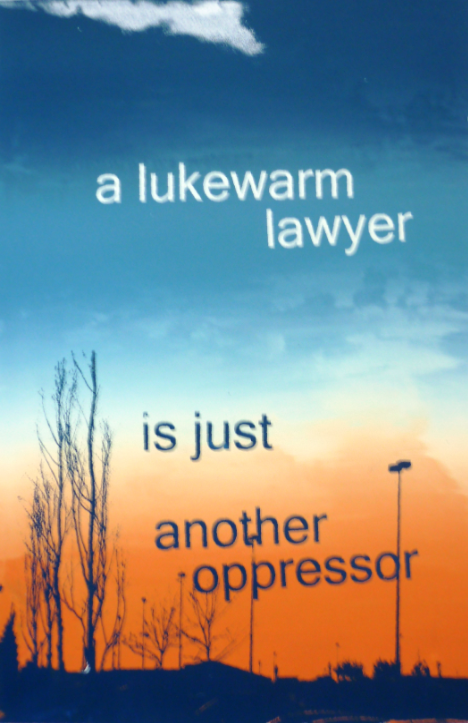
I want to note the image at the top of this piece. It’s a poster designed by a family friend. The phrase comes from a letter I wrote to my wife from prison about the experiences of the men I was helping in the law library. “A lukewarm lawyer is just another oppressor.” In a system where one’s liberty is at stake, indifference is not neutral. It’s harmful.
That’s why reforming this system is serious business with high stakes. For better or worse, lawyers are the guardians of freedom and the gatekeepers of the prisons. The public defense bar is the only thing that stands between a poor person and a jail cell.
I wrote this article because I still believe that when people begin to know better, they will want to do better, which is why I started In Our Name in 2012, and more recently Society Impact. There is much work ahead of us.
If you are interested in the evolution of post-Gideon case law regarding Sixth Amendment rights from this period, I’ve compiled a useful list below:
Gideon v. Wainwright (1963)
McConnell v. Rhay (1968)
Illinois v. Allen (1970)
United States v. Taylor (1973)
Faretta v. California (1975)
Holloway v. Arkansas (1978)
Lowery v. Cardwell (1978)
Cuyler v. Sullivan (1980)
Wood v. Georgia (1981)
United States v. Welty (1982)
Strickland v. Washington (1984)
Nix v. Whiteside (1986)
Wheat v. United States (1988)
United States v. Monsanto (1989)
People v. Sides (1990)
United States v. Goldberg (1995)
Jones v. Stinson (2000)
Gilchrist v. O'Keefe (2001)
Fischetti v. Johnson (2004)
Wilkerson v. Klein (2005)


Comments